ModelStory: Set in Stone

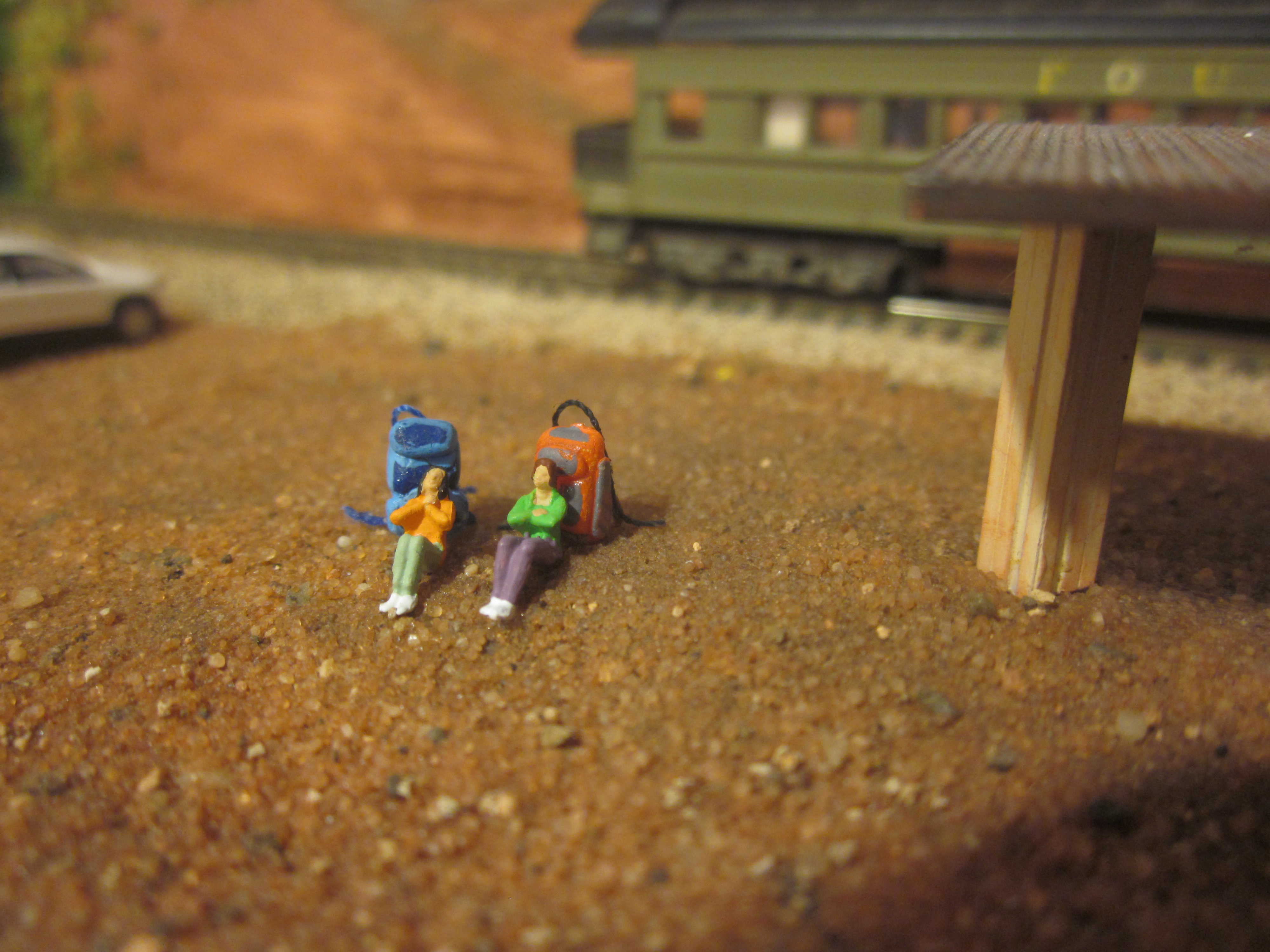
IMG_2885The fossilized footprints of a tiny, undiscovered Triassic dinosaur secreted away in Felicia’s enormous backpack will one day leave a permanent impression on her life.

She chipped them from the Chinle Formation – inside Many Lost Ways National Park – so if the small square of stone is found out, it’s a $10,000 fine and three years imprisonment.

But she sees herself as a scientist and isn’t she here doing research for her BS in geology?

She closes her eyes and daydreams with the sun on her face.

Yes, a scientist and one day that stone, carefully polished and mounted, will hang behind her desk and students will marvel at its beauty and the brilliant professor who collected it.

That’s the dream but here’s the problem: Felicia is a struggling student. Geology isn’t her passion.

Cutting and polishing stone is and she’s darn good at it. She has a remarkable eye for the textures and colors, which suits her more to a career in countertops or terrazzo floors – good paths in an age of diminishing craftsmanship – but we’ll get to that.

First she needs to graduate.

(Don’t worry about the Federal Penitentiary. She won’t get caught.)

Felicia is carrying a 2.73 grade point average. It is her final semester. She needs every one of the 20 credits on her schedule to receive her degree.

Fifteen credits are actual classes and she’s pedaling hard for four Bs and a C. The other five credits are the self-study “senior symposium” she sold to the guidance office.

Add Working the System to polishing rocks. She’s good at that, too.

She’s convinced the school that a seven-day backpacking trip with her friend Cameron (an actual geology student) is worth five credits. They’ll co-write a paper, give an oral presentation and voila, she’ll walk the stage with a 3.0.

Then?

Then a half-hearted effort at getting into grad school, but she doesn’t really want it and she can’t overcome her transcripts anyway. She will apply to three schools and be accepted by none.

Fine.

There’s a guy who loves her and they’ll do well. She’ll fall back on her Way with People and sell corrugated packaging, adjust claims and eventually inspect worksites for OSHA. (Good thing that Federal background check came up clean).

Years from now she and hubby will move into a new house. The granite countertop guy will be there when the movers split open a fatigued old box and the fossilized footprints of a tiny, undiscovered Triassic dinosaur will tumble out.

A pot of coffee and a long conversation later, she’ll partner with the countertop guy and the little contractor will do $7 million the next year.

During that year, Professor Cameron will lead her annual “senior symposium” to Many Lost Ways. Secreted in her giant backpack will be the fossilized footprints of a tiny Triassic dinosaur. She’ll have a decision to make: Discovering them would define her career, but she will probably just leave them behind.

(Scratchbuilt Play-Doh backpacks, Preiser figures.)

Operating the FCFL: Globe, Gallup and the End of a Long Day

Last week the Herbst Junction turn was returning to Salvation Point after working the Red Earth Co-op and the Salvation Point industries. This week the operating session comes to a close with runs to Globe and Gallup, and the Phoenix-Salvation Point-Durango train passes through to clean everything up for next time.

Globetrotting

Globe is not modeled on the layout, but is merely a destination in Southwest Staging. It’s a simple out-and-back operation, with a little work to do at Herbst Junction.

The crew of train SPG31 heads west from Salvation Point Yard and descends into the Benjamin-Henry Canyon. Arriving at Herbst Junction, the crew picks up any Globe-bound loads spotted there by the Herbst Junction turn.

IMG_2801

IMG_2802

With everything coupled up once again, the crew selects the diverging route toward Globe and gets underway.

IMG_2805

IMG_2806

In staging, the inbound loads are cut off and the locomotive is backed up to the outbound train we placed during setup.

IMG_2808

SPG31 crosses back to the main at Herbst Junction and highballs back to Salvation Point.

IMG_2811

Gallup

The Gallup turn is the only eastbound local. SPL41 rumbles out of Salvation Point Yard and up the hill toward Many Lost Ways National Park.

IMG_2813

IMG_2815

At Northeast Staging, the train pulls to a stop just short of the outbound Gallup loads we spotted during setup. The staging yard is a fiddle yard, so the locomotive is simply picked up and turned around, then coupled to the outbound train.

IMG_2817

The inbound cars are manually removed from the track. Their assignment cards are turned to the next destination, and they are staged as the outbound train for the next operating session. Train SPL41 then rolls back to Salvation Point.

PSPD12 – The Last Train Done Left Town

While the Gallup crew is heading out of Northeast Staging, the last train of the day is getting underway in Southwest Staging. PSPD12 was also staged at setup, with freight for Durango up front and loads to be handed by the Salvation Point locals in the next session out back.

The long freight heads across the Benjamin-Henry River enroute to Salvation Point.

IMG_2820

The Salvation Point yard crew has set out all of the outbound Durango freight. When PSPD12 arrives in Salvation Point, the crew pulls the locomotives and the cars continuing to Durango forward, then backs onto the siding where the outbound Durango work awaits.

IMG_2822

IMG_2824

When that’s hooked up, the train regains the mainline and powers up the hill to Northeast Staging. Its arrival there marks the end of another long day on the FCFL’s Four Corners Division.

IMG_2825

Filler Traffic

The layout is nearly ready for more formal operating sessions with more operators. I need to work out the timing to allow the trains to run on a schedule rather than just sequentially. I will also include in the schedule Amtrak’s Badger State, the steam tourist shuttle, and a Union Pacific coal drag that runs on trackage rights over the FCFL. This will add an extra challenge as crews will have to wait for clear track and give way to priority trains.

Here SPL41, a Gallup local, waits for a UP coal train borrowing FCFL power to clear the main:

Adding even a low-key operating system like mine adds to the fun of any model railroad!

Operating the FCFL: Salvation Point Industries and Herbst Junction

IMG_2787When we left off last week, the Flagstaff local had just arrived in Salvation Point, and the yard crew was sorting out the freight.

Now the yard crew has assembled another challenging local job, Train SPH21, which switches the local industries in Salvation Point as well as Red Earth Co-op in Herbst Junction.

A Push-Pull Operation

The Red Earth Co-op siding faces west, so a locomotive pulling cars from Salvation Point would need to perform a runaround maneuver to pick up and spot cars. The passing siding at Herbst Junction can accommodate no more than three cars, so to work the co-op the train has to be pushed from Salvation Point. This is a long push move on the main line, so a caboose is employed to protect the train. It’s not really necessary, but I like a caboose now and then and it adds a little complexity to the work.

There are two industries in Salvation Point. Paul Power’s spur faces east while Midtown Construction Materials faces west. The train is blocked with the Paul Power work on the west end and Midtown’s cars to the east.

The crew runs the locomotive around on the passing siding and couples on to the caboose, shoves the train up to Midtown and switches the inbounds and outbounds.

IMG_2793The locomotive is run around to the east end of the train again at the passing siding, and backed down to Paul Power to work the traffic there.

IMG_2794

IMG_2795


The train is reassembled and the caboose leads the way down into the Benjamin Henry Canyon.

IMG_2797

At Herbst Junction, the crew works the Red Earth Co-op spur. Any loads bound for Globe are spotted on the short siding by the depot.

IMG_2798

IMG_2799

This Red Earth Co-op hopper (with patches) is bound for Globe. Rather than haul it to Salvation Point, it is spotted in Herbst Junction for the Globe Local to grab later.

The train is reassembled and the crew returns to Salvation Point in time for lunch.

sign

Next week: The Globe and Gallup locals, and the end of a long day on the job.

Operating the FCFL: Salvation Point Yard and the Flagstaff Local

yard composite horiz

FCFL’s Salvation Point Yard

Last week train DSPP10 dropped a string of cars at Salvation Point on its way to Phoenix (AKA Southwest Staging). This week the Salvation Point yard crew gets to work sorting those cars and building the “local” trains that will deliver them to cities and industries across the layout.

Yard Work

IMG_2692The busiest locomotive in the fleet is the MP1500DC switcher assigned to Salvation Point Yard. The yard crew cuts apart the string of cars left behind by the Phoenix-bound DSPP10, and sorts them by destination: Flagstaff, Salvation Point industries, Herbst Junction, Gallup, Globe. The crew then builds the local trains that will work those destinations.

SPF11 – The Flagstaff Local

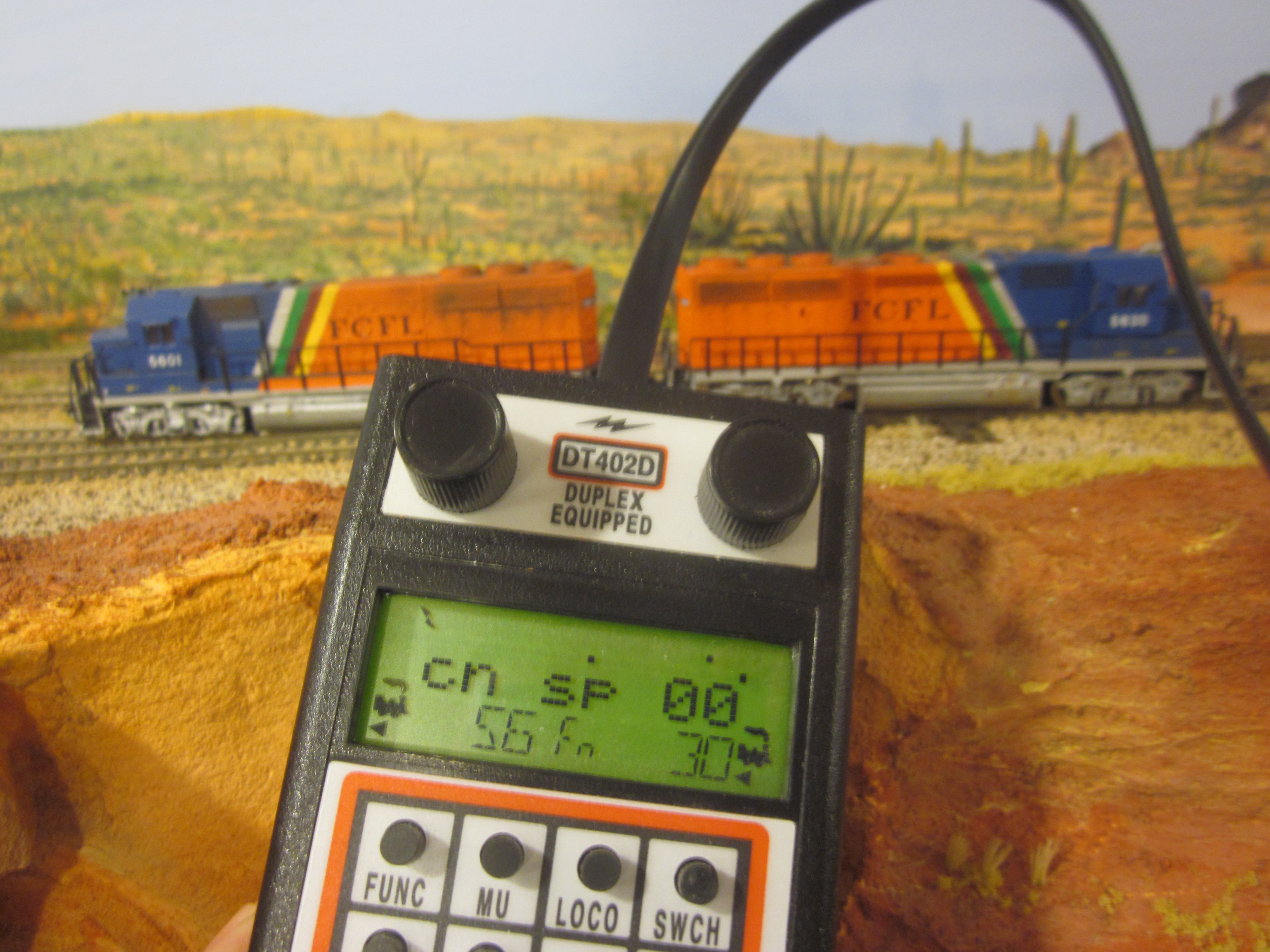
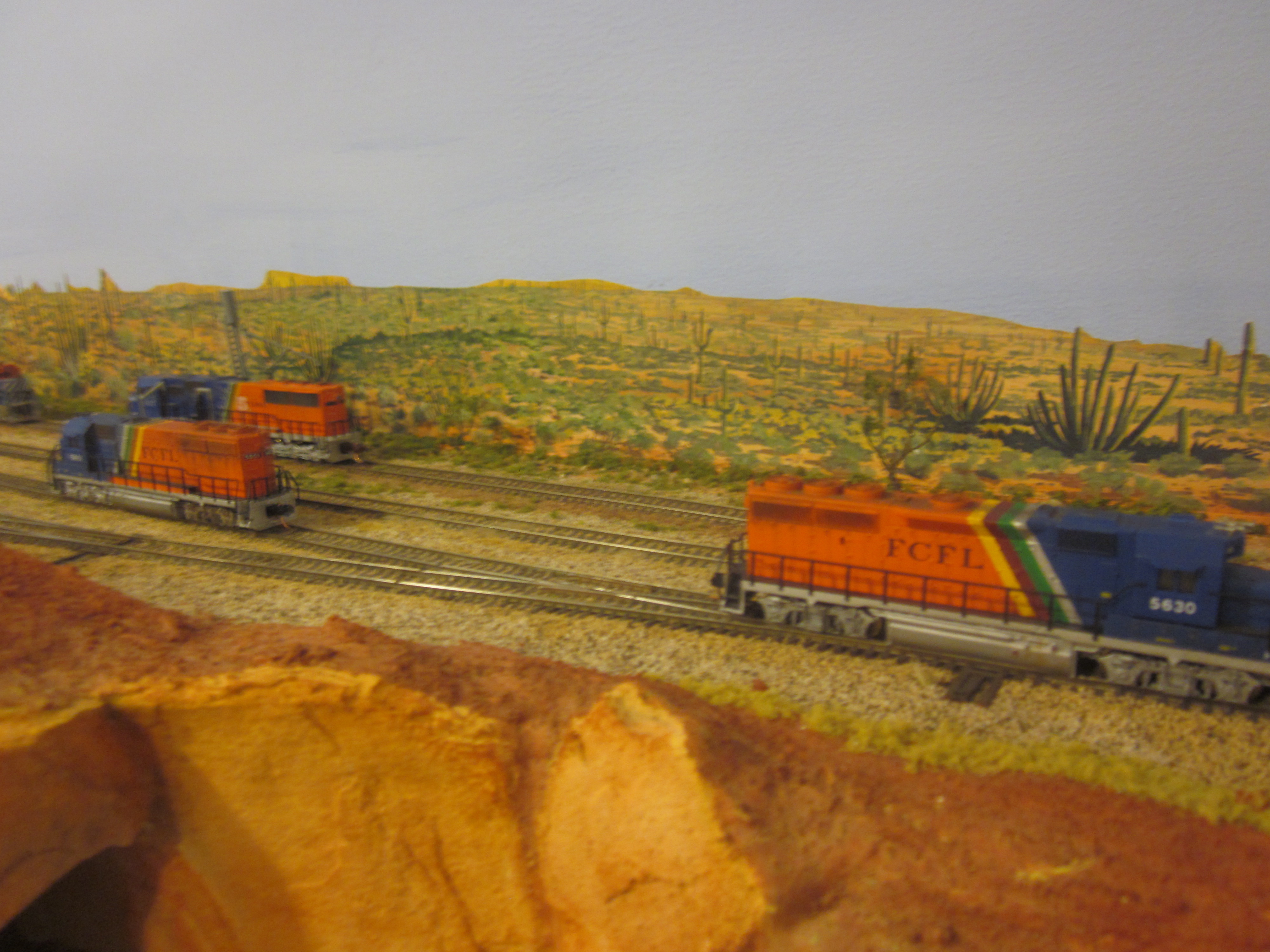
The first local on the schedule is the Flagstaff turn, Train SPF11. Flagstaff presents some challenging switching, with industrial spurs facing east and west. Just getting to Flagstaff from Salvation Point requires the train to reverse direction. To help the crew manage it all efficiently, SPF11 is built with a locomotive at each end. Here is where Digital Command Control (DCC) is essential.

With the Flagstaff cars sorted, the power is brought from the hostler track. The locomotives are cut apart, with one placed on each end of the train:

IMG_2768

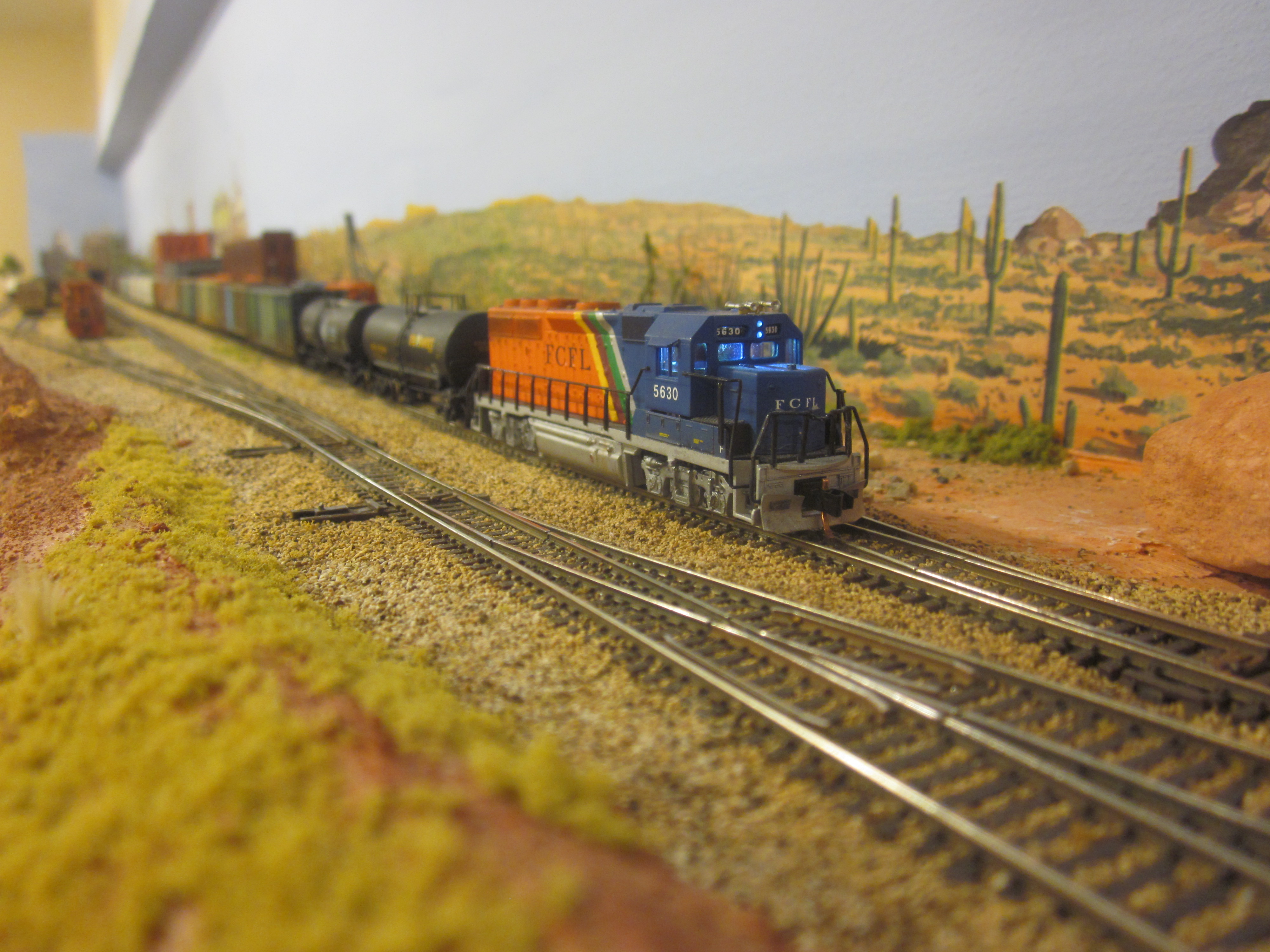
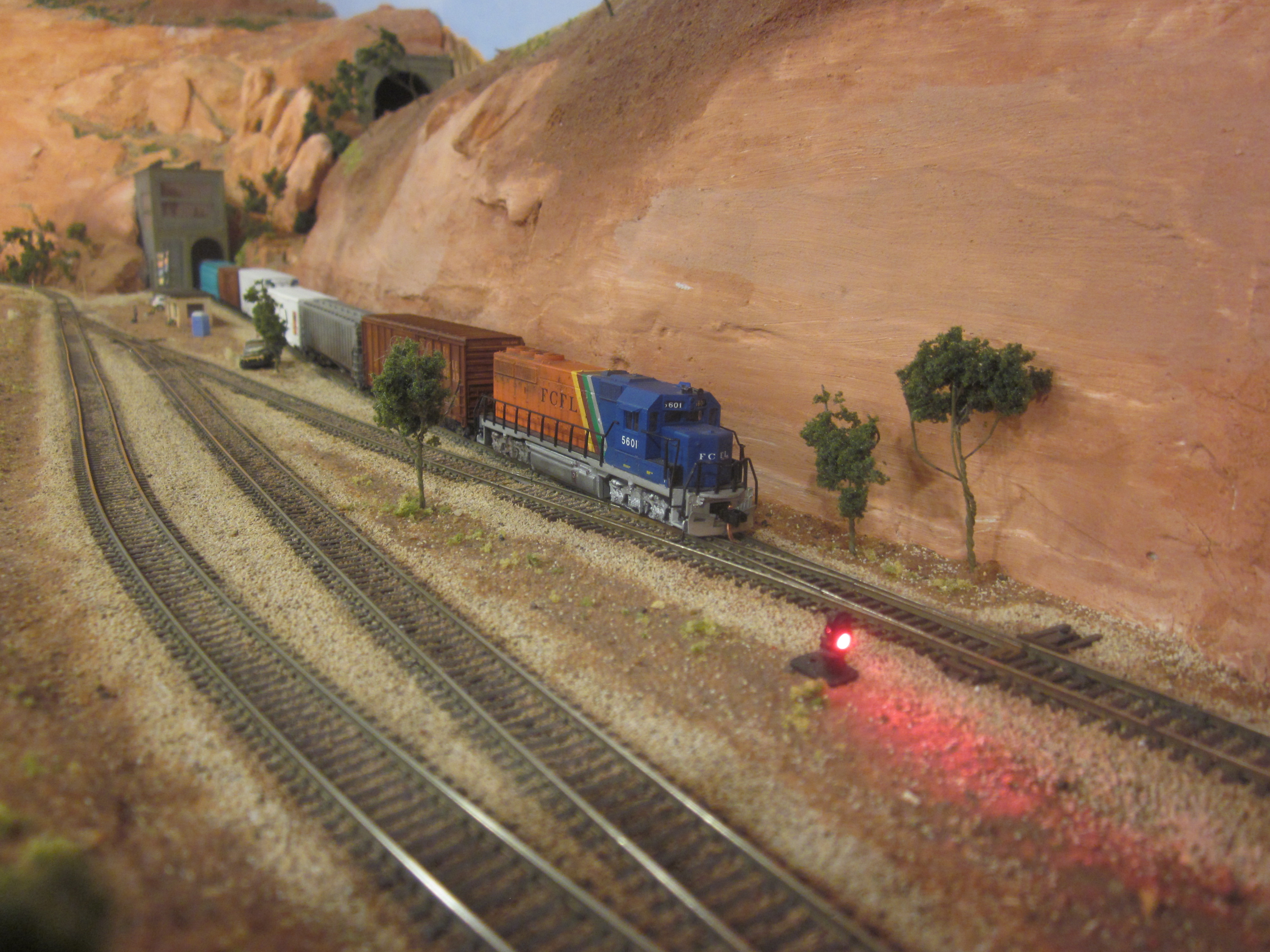
Engine 5601 (DCC address 56) and 5630 (address 30) are set up for multiple unit operation. While in a “consist” like this, both units respond to the same throttle commands.


IMG_2771

The consist is broken, allowing the engines to operate independently.


IMG_2774

The locomotives are cut apart, and one is sent down the line to be on the head end of the train.


IMG_2775

IMG_2777

The other locomotive pulls the Flagstaff cars from the yard and shoves them up to couple with the first locomotive. The consist is re-established and the train is ready to roll.


The train heads east, downhill into the Benjamin-Henry Canyon and pulls up short of the crossover at Herbst Junction.

The crew selects the diverging route and pulls clear of the turnout on the branch line.

IMG_2780Taking up residence in the locomotive now facing west, the crew throttles up and heads through The Cell into the longest tunnel on the FCFL.

IMG_2781

Arriving in Flagstaff, the locomotive consist is broken again. One engine switches the industries with east-facing sidings, the other works the west-facing sidings.

IMG_2784

IMG_2786

With the inbound cars all spotted and the outbound cars all pulled, the train is assembled with a locomotive on each end for the trip home.

IMG_2785

The reverse move at Herbst Junction is repeated, and the train finally arrives back in Salvation Point.

IMG_2787

Next Week: We work the local industries in Salvation Point and make a run to Herbst Junction.

Operating the FCFL: Setup and the Durango – Salvation Point – Phoenix Run

Last week I introduced my laid-back operating scheme for the FCFL. This week I’ll describe the setup for an operating session and run the first train of the day.

A Note About Staging

It’s helpful to think of the layout as a theatrical stage. The “scenicked” portions are where the drama plays out, while the staging yards are the wings. There are rules for the stage and rules for the wings. On stage, cars can only move by locomotive power. Nothing gets picked up. The only manipulation allowed is a little help coupling or uncoupling, and a gentle nudge if a locomotive looses electrical pickup.

The staging yards are “fiddle” yards where none of those rules apply. Operators are free to pick up and move engines and cars, and rolling stock is moved by hand between storage boxes and the layout.

Setup

Setup starts in the storage boxes, where I select cars to place at industries around the layout, and to include in the trains that start in staging.

In addition to placing cars at industries, I assemble trains in staging for Globe, Gallup and Phoenix. Later we will run local trains from Salvation Point to Globe and Gallup, and these trains placed in staging at setup will be hauled back to Salvation Point.

IMG_2727

Each car’s envelope is stuffed with an assigment card, as discussed in the last post.

Each industry has a nail driven into the benchwork beneath it. Binder clips holding the envelopes for the cars spotted there are hung from the nail.

IMG_2766

IMG_2765

Once the layout is staged in this manner, each successive operating session requires minimal setup.

Durango – Salvation Point – Phoenix: Train DSPP10

IMG_2742

Train DSPP10 ready to go in Northeast Staging. This “unscenicked” area of the layout is like the wings of a theater, where the actors and props are staged for action. Also visible in this picture are trains staged at Globe, Gallup and Phoenix.


DSSP10 is one of the trains assembled by hand in staging. I use a technique employed by real railroads called “blocking.” Cars heading toward similar destinations are grouped together in the train. For the Durango – Salvation Point – Phoenix train, I place the cars bound for Phoenix up front just behind the locomotives, and everything else follows.

The envelopes for the cars on the train are stacked on a clipboard for the crew to carry.

IMG_2743

The train departs staging, crosses the Benjamin-Henry River and briefly passes through Many Lost Ways National Park before descending into Salvation Point.

IMG_2744

Train DSPP10 arrives in Salvation Point.


When DSPP10 arrives in Salvation Point, all the cars not continuing on to Phoenix are cut off. The yard crew uses the yard goat, a MP1500DC, to pull the local traffic clear and shunt it into the yard.

IMG_2745

IMG_2746

Any cars in Salvation Point bound for Phoenix are then coupled to the end of DSPP10.

IMG_2748

Then it’s a straight shot through the canyon, past Herbst Junction and into Southwest Staging. When DSPP10 arrives in staging, the locomotives are cut off and coupled to train PSPD12, the Phoenix – Salvation Point – Durango train that will be the last “run” of the day. These cars were staged here during setup.

IMG_2758IMG_2760

The assignment cards on the arriving train are all turned to their next destination. The cars are manually re-blocked according to their new assignments, thus creating the Phoenix – Salvation Point – Durango train for the next session.

IMG_2761

Next week: Action picks up in Salvation Point, where the yard crew gets busy assembling the local trains for Flagstaff, Herbst Junction, Gallup and Globe.

ModelStory: A River Deep and Wide

At first the thing that bothered him most about the whole idea was that they might fall.

IMG_2477[1]

“At first the thing that bothered him most about the whole idea was that they might fall.”

As a dad, falls are a major concern. Traffic and roadway hazards are a close second, followed by choking and other ingestion-related dangers. Dads tend to worry about the things that cause immediate trauma.

Moms fret over the hazards of repeated exposure like dressing properly for the weather and adequate nutrition.

Dads worry about falls.

So the notion that his daughter and her cousin would embark – unchaperoned – on a three-hour river raft trip caused him some heartburn.

(It had to be a three-hour tour? The universal code for nautical tragedy?)

“They’re fourteen years old, Ted,” said Marcia. “As long as you’re there to pick them up on time, how much trouble can they get into? Frankly I was looking forward to some time alone during this vacation. Just me and the Discover Card and those cute shops in Salvation Point.”

That didn’t make him feel any better, but he realized he was licked and agreed to drop them at the dock.

And now he stands here all alone experiencing one of those unforgettable moments of immense transition:

She WON’T fall.

She’s fourteen and a pretty good swimmer and smart enough to stay seated.

She’s not the little girl who couldn’t help but skip everywhere she went, the one who fell out of bed and fell off the jungle gym and fell off her bike and needed him to fix her up and remind her to pay attention.

She hasn’t needed any of that in a long time. She’s done some growing up, and he wishes he’d been paying closer attention.

Because there’s this boy, sitting right across from her, and they’re not fifty feet from the dock and already talking to each other.

She’s going to have different kinds of falls now, harder ones to recover from.

He’s not sure he’s ready.

*   *   *

At first the thing that bothered her most about the whole idea was that she might fall.

As a kid, falls were a major concern. Falls out of bed and falls off the jungle gym and falls off her bike – and Dad was always there to fix her up and remind her to pay attention.

IMG_2484[1]

“At first the thing that bothered her most about the whole idea was that she might fall.”

So the notion that she would embark with her cousin on a three-hour river raft trip without him had her freaking out a little.

(Dad kept singing some stupid song about a three-hour-tour, a THREE-HOUR TOUR, like that meant something.)

“We’re fourteen years old,” said Brittney. “As long as he’s there to pick us up on time, how much trouble can we get into? Besides, it’s better than hanging out with your mom in town.”

She didn’t entirely agree with that, but she realized she was licked and agreed to be dropped at the dock.

And now she sits here experiencing one of those unforgettable moments of immense transition:

She WON’T fall.

She’s fourteen and a pretty good swimmer and smart enough to stay seated.

She hasn’t needed to worry about falling or choking or getting hit by a car in a long time. She wishes she’d paid more attention to the growing up she was doing.

Because instead of Dad – well, hello cute boy across from me!

The falls are about to get harder.

She’s not sure she’s ready.

(Scratchbuilt river raft, factory-painted Preiser and custom-painted Model Power figures, EnviroTex Lite water with clear silicone caulk effects.)

Operating the FCFL

IMG_2692

FCFL MP1500DC #534 sorts a string of cars at Salvation Point Yard. The FCFL uses a “car-card” operating system to route cars across the layout.

For my 10th birthday or so my Dad gave me an Athearn F7 A and B set in the Santa Fe warbonnet scheme and when my friends came over for my birthday party I proudly showed it off, lap after lap, on our HO layout.

I still remember my friend Steve asking, “So all you do is run it?”

No, my friend. We don’t run trains. We operate them.

Some guys golf, some guys make their own beer, I use a home-grown car-card system to route model train cars to various destinations on my model railroad layout.

Yes, that’s a thing.

IMG_2719One of the finest examples I’ve seen is the Ford City Northern – the spectacular freelanced layout of a friend from the railroad club. He runs formal operating sessions and has manuals, handbooks and schedules for the trains.

My operations are pretty rudimentary by comparison, but I think my system is still pretty fun. Over the next few posts I’ll describe it.

If you’re a model railroader, maybe you’ll get an idea or two for your own layout. If you’re not a model railroader, it’s not too late.

The Schedule

IMG_2713The layout operates sequentially. A typical “day” (which may take a week or more) goes like this:

Train DSPP10: Durango – Salvation Point – Phoenix

Train SPF11: Salvation Point – Flagstaff – Salvation Point

Train SPH21: Salvation Point (local industries) – Herbst Junction – Salvation Point

Train SPG31: Salvation Point – Globe – Salvation Point

Train SPL41: Salvation Point – Gallup – Salvation Point

Train PSPD12: Phoenix – Salvation Point – Durango

The Car Card System

Each of my model train cars has a little paper pocket with its road number, physical description and car type on the front. I am gradually upgrading them to neatly printed labels with a photo of the car. For now most of them (okay, all of them) look like this:

IMG_2684

I make the pockets by sealing stationary envelopes and cutting them in half.

The pockets fit “assignment” cards – 3×5 cards that have four destinations written on them. The destinations are numbered one through four.

IMG_2690

The car is delivered to destination one, then at the next operating session to destination two, and so forth. The fourth destination is always one of the staging areas, where the car is taken off the layout and stored until called upon for another cycle.

I have made assignment cards for all the different kinds of rolling stock on the layout – boxcars, grain hoppers, plastic pellet hoppers, refrigerated cars, gondolas, etc. Eventually I’d like to start a session by pulling 20 cards for the Durango-Phoenix run and then going to the storage boxes to find the appropriate rolling stock. The fleet isn’t large enough to accommodate that yet. For now, I have to figure out what cars I have available and sift through the assignment cards to find matching loads.

Next week: I’ll walk through the setup, and we’ll ride along on the Durango-Salvation Point-Phoenix run.